.png)
Kicking Off Another Year with Concepts in Mind: Getting Started in a Concept-Based Literary CLassrooM

I’ve spent the summer doing what teachers do best—overthinking. Not bulletin boards (though, yes, they’re still half-done) but something much bigger: How do I set the stage for deep, transferable literacy learning right from day one?
I didn’t start out as a “Concept-Based” person. In fact, my early years as an English teacher were spent firmly in the skill-based camp. Shifting into Concept-Based learning required a genuine paradigm shift. I had to put on a new set of teacher glasses and look at my role—and my classroom—through a very different lens.
I remember wondering:
What exactly is a concept?
What does it actually mean for students to inductively realize a generalization?
And why on earth did I not learn about this approach sooner?
I had a Master’s in Special Education. I had earned National Board Certification in English language arts. Yet I had never been explicitly taught how to leverage the power of concepts in a literacy classroom.
When I finally started crafting generalizations and guiding questions, and teaching a bit more inductively, everything clicked. I watched as abstract ideas in literature became accessible through carefully designed, inquiry-driven case studies. Threads of conceptual thinking pulled students toward deeper understandings than I had ever witnessed before.
Was it perfect? Absolutely not. The path was full of bumps, doubts, and moments where I felt in over my head. (Sound familiar?) But the payoff was undeniable.
Questions We’re All Asking
If you’re still curious about what Concept-Based Inquiry looks like in practice, you’re in good company.
Questions I often hear—and ask myself—include:
What role do our tried-and-true instructional moves (like book talks or independent reading routines) play in a Concept-Based classroom?
How do I make sure students are actually doing the thinking, not me?
How do I move beyond teaching skills in isolation and help students develop transferable conceptual understandings?
Spoiler alert: these are the kinds of questions that don’t go away, even in year 20 of teaching.
Back-to-School Reflections
With one week left before school starts, my own brain is toggling between the immediate (helping students build capacity for academic conversations) and the long-term (designing a unit that strengthens argumentation).
I’m also sifting through classroom routines:
Which entry tasks will spark thinking from day one?
How do I want to approach at-home independent reading this year?
Did last year’s book talks really do what I wanted them to do—or do I need to shake it up?
Even after two decades in the classroom, I find myself constantly reflecting, refining, and asking “How could this be better?”
A Resource to Ground Us
Before I dive deeper into my planning process, I want to leave you with a touchstone from my book Concept-Based Literacy Lessons: Designing Learning to Ignite Understanding and Transfer (Lanning & Brown, Corwin, 2019).
Take a look at the visual below, which contrasts traditional two-dimensional skill-based instruction with three-dimensional Concept-Based Literacy. Keep it nearby this year—it’s a powerful lens to apply as you design learning experiences.
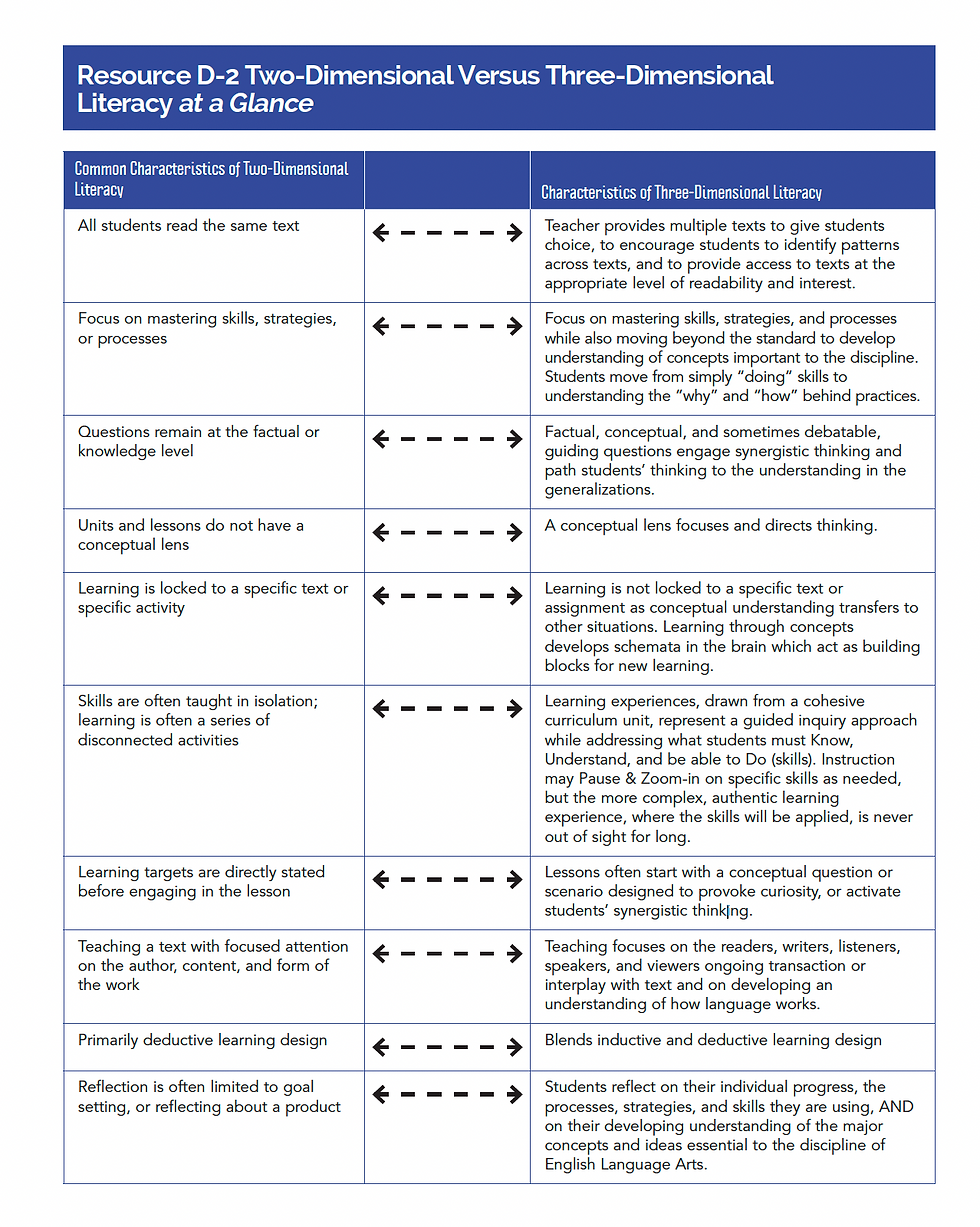
And here’s a quick challenge: What comes to mind when you think about a Concept-Based approach in literacy? How does the resource confirm, shift, or stretch your thinking?
Let’s Keep the Conversation Going
I’ll be sharing more about what this looks like in real time as the school year unfolds. In the meantime, I’d love to hear from you—what questions are you wrestling with as you set up your own classroom for the year ahead? Drop a note on Facebook or X and let’s connect.
Here’s to another year of learning, reflecting, and stretching our students (and ourselves) toward deeper understanding.


Comments